

Required Minimum Distributions: Making the Most of What You've Saved
For many retirees, the Required Minimum Distributions (RMDs) are simply a fact of life. Once you reach age 73, the IRS requires annual withdrawals from most traditional retirement accounts, whether you need the income or not. If you fail to take the full Required Minimum Distribution by the applicable deadline, the IRS may assess an excise tax on the amount that should have been withdrawn but was not.
The good news is that an RMD does not have to be viewed as just another tax obligation. With thoughtful planning, it can become a tool to support personal goals, family priorities, and the causes that matter most to you.
What Can You Do With Your RMD?
Charitable giving is only one option available when taking an RMD, but many retirees find it to be one of the most rewarding ways to put retirement assets to work for future generations.
In most cases, an RMD from a traditional IRA is taxable as ordinary income in the year it is distributed, regardless of how the funds are used afterward. Whether the money is spent, saved, invested, gifted to family members, or donated to charity after it is received, the distribution is generally included in taxable income. An important exception is a Qualified Charitable Distribution (QCD), which is paid directly from an IRA to a qualifying charity and may satisfy all or part of an RMD without being included in taxable income.
Certain charitable strategies may provide additional tax benefits, but individuals should consult their tax professional regarding their specific situation.
Common options of how to use your Required Minimum Distribution include:
Using the funds for retirement spending
Reinvesting them in a non-retirement account, such as a brokerage account
Helping family members
Supporting charitable causes
Incorporating the distribution into broader legacy planning, such as making gifts to children or grandchildren, funding education savings, or supporting future charitable goals
How does the IRS calculate the Required Minimum Distribution?
How does the IRS calaculate the Required Minimum Distribution for your IRA?
Answer: your IRA balance on December 31st divided by the IRS life expectancy factor will equal your required annual RMD.
What is the IRS Life Expectancy Factor? The IRS life expectancy factor generally declines as you age, which means a larger percentage of your account must be distributed over time. See the sample ages and factors in the IRS chart below.
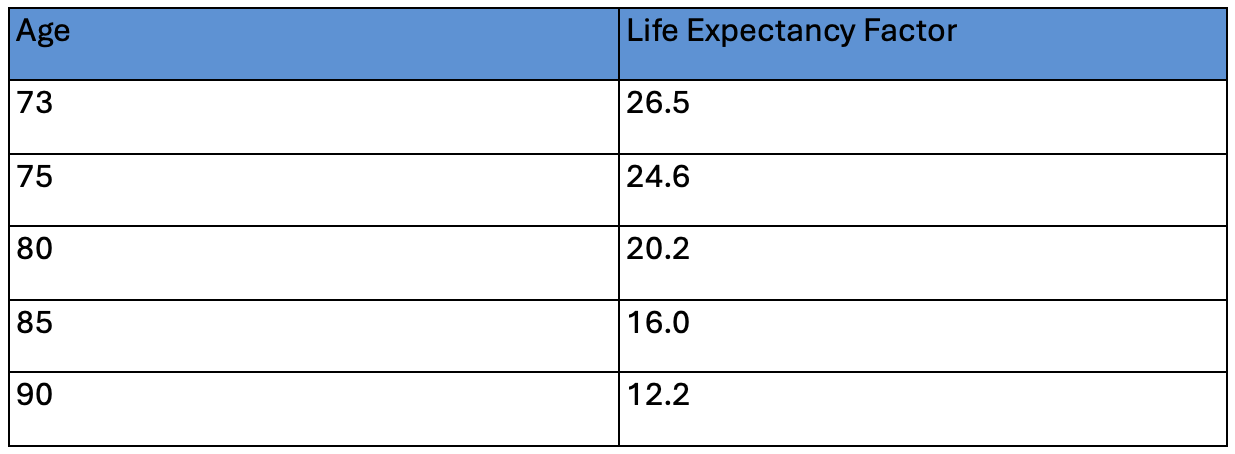
Chart showing correlation between age and the life expectancy factor used by the IRS in calculating Required Minimum Distribution from an IRA
As an example, if you are 75 years old and had a December 31st IRA balance of $500,000, then the IRS’ RMD calculation would be: $500,000 ÷ 24.6 (Age 75) = $20,325. You would be expected to take at least this amount out of your IRA. Most custodians make this process relatively simple. The funds can be transferred directly to a bank account, sent by check, or, if desired, withheld for federal and state taxes at the time of distribution. Many retirees also establish recurring withdrawals throughout the year rather than taking a single lump-sum distribution.
Giving Back to the Community
If your RMD exceeds your spending needs, consider whether a portion of those dollars could support the organizations and causes that have meaning in your life. For example, community foundations such as the Park County Community Foundation (PCCF) help connect charitable resources with local opportunities, allowing donors to create a lasting impact close to home. Because of its 501c3 status, PCCF can accept Required Minimum Distribution donations and can strategically invest the donation in local nonprofits who are working on the issues about which you most care.
As always, consult your tax professional and financial advisor before making decisions regarding your Required Minimum Distribution strategy.

July Hardesty, AWMA, Edward Jones
For more information about Required Minimum Distributions — take a look at these free resources from financial advisory July Hardesty, AWMA at Edward Jones in downtown Livingston. Reach out to July here.